Before It Becomes Normal
On Innocence, Awareness, and the Things We Learn to Accept

When a child is born and through the time that they’re growing up, great emphasis is placed on preserving the child’s innocence. That’s the goal. And it takes great effort.
Parents watch what their children are exposed to. They monitor what they watch, what they hear, who they spend time with, and the experiences they have. At first glance, it seems obvious why. Nobody wants their child exposed to trauma, violence, cruelty, or suffering. But the more I think about it, the more I wonder why- like really, why?
The common explanation is that negative experiences leave deeper marks than positive ones. We remember criticism longer than praise. A single betrayal can outweigh years of trust. One traumatic event can shape a lifetime. In a Gottman book I was reading, they suggested that for every negative comment or gesture in an argument, it takes roughly five positive ones to overcome it. If that’s true, then negativity seems to carry a disproportionate amount of weight. It isn’t an even exchange. The scales aren’t balanced.
But there’s more to it than that...
The more I think about it, the more I wonder if parents aren’t protecting innocence because children are fragile. I’m starting to wonder if they’re protecting innocence because children are adaptive.
Children get used to things… In some ways, that’s exactly what makes children so resilient. It’s also what makes them vulnerable.
A child raised around honesty comes to expect honesty. A child raised around kindness comes to expect kindness. A child raised around screaming comes to believe screaming is simply part of relationships. A child raised around chaos comes to expect chaos.
Whatever a child repeatedly experiences eventually becomes normal.
Because exposure doesn’t merely teach us what exists. Exposure teaches us what is acceptable. What is tolerable… or normal…
Maybe that’s why parents try so hard to protect innocence. Not because innocence is ignorance, but because innocence preserves standards.
In fact, I wonder if parents protect innocence because they understand that exposure doesn’t just teach children about the world- it shapes what kind of world they will come to accept.
Without prior exposure to certain things, a child encounters them and immediately recognizes that something is wrong. If a child has only known kindness, cruelty feels foreign. If they’ve only known honesty, deception feels unsettling. If they’ve only known respect, disrespect feels unacceptable. Their instinctive reaction is, “What the hell is this?”
They haven’t been exposed to it long enough to mistake it for normal.
But repeated exposure changes that.
Eventually the shocking becomes familiar. The familiar becomes normal. And the normal becomes tolerated.
Nobody wakes up one morning and consciously decides to lower their standards. They simply become accustomed to what surrounds them.
That’s true for children- but it’s true for adults too…
We see it in relationships. We see it in workplaces. We see it in culture. We even see it in ourselves.
Things that would have horrified us ten years ago barely get a reaction today. Behaviors we once swore we’d never tolerate somehow become things we learn to live with. We don’t usually abandon our standards all at once. We adapt to them one compromise at a time.
And eventually what we tolerate begins to shape what we participate in.
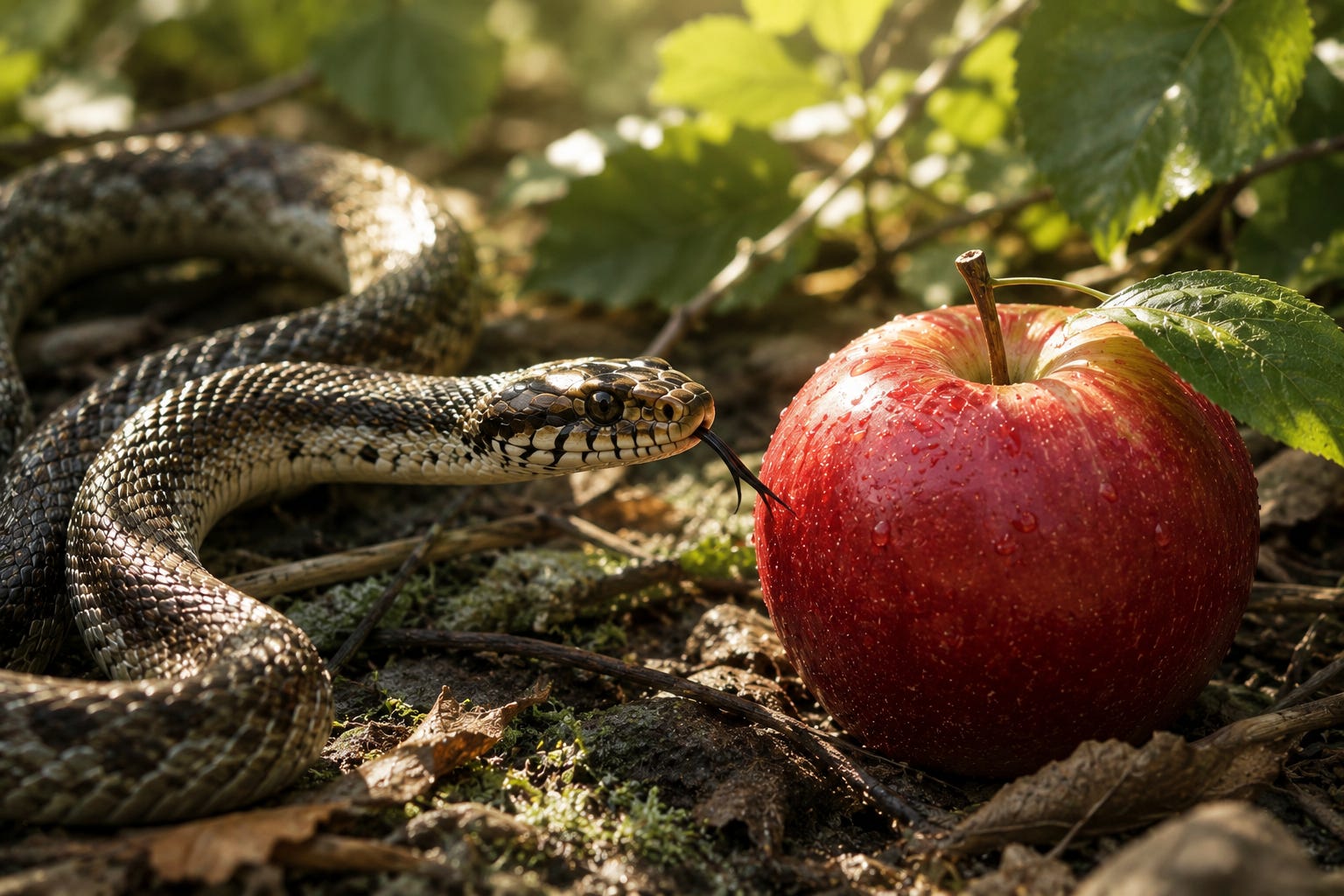
That’s what made me start thinking differently about the story of Adam and Eve.
I’ve always heard the story framed as one of disobedience. But lately I’ve wondered if it was really about awareness.
It’s not as if Adam and Eve became evil after eating from the tree- that’s not even how the story goes. They became aware. Aware of shame. Aware of vulnerability. Aware of fear. Aware of possibilities that had not previously existed in their minds.
And perhaps that’s the important part.
Because once a possibility exists in the mind, it can no longer be treated as impossible.
Betrayal, cruelty, and deception don’t simply become things we know about. They become possibilities we must account for.
And maybe that’s where innocence is truly lost.
Not simply in the awareness itself, but in what follows.
Because once we’ve been exposed to certain possibilities, we begin guarding against them. We become cautious where we were once trusting. Defensive where we were once open. Suspicious where we were once certain.
And if we’re not careful, we can end up projecting onto others the very things we fear for ourselves—treating people as though they’ve already committed the offenses we’re trying to protect ourselves from.
The person betrayed, abandoned, or lied to- they begin to look for it.
In an effort to protect ourselves from being hurt again, we sometimes carry yesterday’s wounds into today’s relationships.
Once you know, you can’t unknow.
That’s the thing about certain kinds of knowledge. It never arrives alone.
You don’t just learn that betrayal exists. You lose the ability to believe betrayal is impossible.
Once you learn that people die, you lose the assumption that the people you love will always be there.
And once a person is exposed to cruelty- I mean, really exposed- they lose the belief that everyone means well.
Some knowledge expands your world, but it also permanently alters the assumptions you make about it.
The strange thing is that human beings seem drawn toward this knowledge despite the cost. Children constantly want to know what the adults are talking about. Teenagers want access to things they’re told they’re not ready for. Adults click the article, watch the video, ask the question, and look behind the curtain.
There seems to be something in us that simply has to know.
Maybe that’s why the story has survived for thousands of years… The serpent didn’t tempt Adam and Eve with pleasure- it tempted them with knowledge.
And perhaps that’s what makes the story so timeless.
Because every human being eventually faces the same choice.
There is knowledge available to you.
You will understand more.
You will see more.
You will become more aware.
But you will never again be the person who didn’t know.
The older I get, the less certain I am that innocence is the absence of knowledge.
After all, ignorance isn’t wisdom.
I wouldn’t want my children to grow up unaware that people can lie, manipulate, betray, or take advantage of them. The world eventually teaches those lessons whether we’re ready for them or not. There is wisdom in understanding reality. There is safety in recognizing danger, and there are simply lessons that must be learned.
But perhaps the challenge isn’t knowledge itself.
Maybe the challenge is learning about darkness without becoming accustomed to it.
Because exposure is unavoidable, but normalization is not.
A child eventually has to learn of cruelty and deceit. The danger isn’t that they’ll know of their existence. The danger is that they’ll come to normalize them.
A child eventually has to learn that relationships can fail. The danger isn’t that they’ll understand heartbreak. The danger is that they’ll stop believing loyalty is possible.
And maybe that’s the question we’re all trying to answer, whether we’re parents or not:
How do you remain aware of the world’s darkness without allowing that darkness to redefine what you consider normal?
Perhaps that’s what parents are really protecting. Not ignorance or naivety.
Standards.
The ability to encounter something broken and still recognize that it is broken.
To understand cruelty, deception, and even darkness- without becoming cynical.
Because what we’re repeatedly exposed to eventually becomes familiar. What becomes familiar often becomes normal. And what becomes normal eventually shapes what we’re willing to tolerate.
Maybe the deeper warning hidden inside the story of Adam and Eve isn’t that awareness is dangerous.
Maybe it’s that awareness changes us.
Once a possibility enters the mind, it doesn’t simply remain knowledge. It becomes something we must contend with. Something we must consciously reject, accept, or risk becoming accustomed to.
And perhaps the cost of eating from the tree was never knowledge itself.
Perhaps the cost was that humanity would spend the rest of its existence deciding what to do with that awareness.